
Get Complete Analysis Of The Report - Download Updated Free Sample PDF
The growth of the global tardive dyskinesia treatment drug market is primarily driven by the rising prevalence of tardive dyskinesia, largely associated with long-term use of antipsychotic medications, which has created a significant demand for effective therapies. The introduction and adoption of novel VMAT2 inhibitors, such as valbenazine and deutetrabenazine, have transformed the treatment landscape, offering improved efficacy and better safety profiles, thereby encouraging higher prescription rates. Additionally, increasing awareness among healthcare professionals and patients about the condition and its management is facilitating early diagnosis and treatment initiation, further fueling market growth. Supportive regulatory frameworks and expedited approvals for innovative therapies are also enabling faster market entry for new drugs.
The Tardive Dyskinesia (TD) treatment landscape is undergoing significant transformation through several key advancements. Serina Therapeutics is driving the emergence of novel therapeutic agents with its POZ-conjugated VMAT2 inhibitor, SER-270, which is advancing into clinical development to address unmet needs in managing this movement disorder. Concurrently, the expansion of drug formulations, exemplified by Neurocrine Biosciences' FDA-approved granule formulation of Ingrezza (valbenazine), is enhancing accessibility and compliance, especially for patients with swallowing difficulties in long-term care settings. Furthermore, the integration of digital health technologies, such as wearable devices and digital symptom tracking, is enabling personalized treatment through real-time symptom assessment and monitoring. These technological and pharmacological innovations are being supported by increased clinical awareness and diagnosis efforts, which are crucial for earlier intervention, though a persistent high rate of undiagnosed patients underscores the ongoing need for continued professional education and standardized screening.
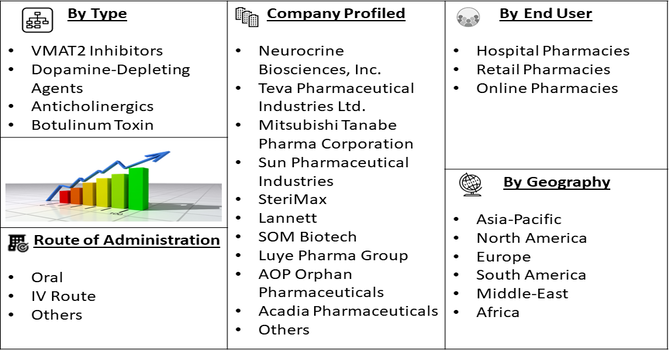
Segmentation: Global Tardive Dystonia Treatment Drug Market is segmented by Drug Class (VMAT2 Inhibitors, Dopamine-Depleting Agents, Anticholinergics, Botulinum Toxin), Route of Administration (Oral, IV Route and Others), End-User (Hospital Pharmacies, Retail Pharmacies, Online Pharmacies) and Geography (North America, Europe, Asia-Pacific, Middle East and Africa, and South America). The report provides the value (in USD million) for the above segments.
For Detailed Market Segmentation - Get a Free Sample PDF
Market Drivers:
The rising prevalence of mental health disorders, such as schizophrenia, bipolar disorder, and major depressive disorder, has significantly contributed to the growth of the tardive dyskinesia (TD) treatment drug market. Patients with these conditions are often prescribed long-term antipsychotic medications, which, while effective for managing psychiatric symptoms, can lead to medication-induced movement disorders like TD. As more individuals receive prolonged antipsychotic therapy, the incidence of TD increases, creating a growing patient population in need of effective treatments. This trend underscores the urgent demand for novel and safer therapeutic options, driving research, development, and adoption of specialized TD medications in both clinical and outpatient settings.
Advancements in therapeutic options have significantly improved the management of tardive dyskinesia (TD), a medication-induced movement disorder. The introduction of novel treatments, particularly vesicular monoamine transporter 2 (VMAT2) inhibitors, has transformed the clinical approach to TD. Valbenazine (Ingrezza) was the first FDA-approved medication specifically for TD, offering a targeted mechanism of action with a favorable side effect profile. Following this, Deutetrabenazine (Austedo) was developed, featuring a deuterated formulation that reduces metabolic fluctuations, allowing for more consistent plasma levels and potentially improving patient adherence and tolerability.
Market Restraints:
The newer medications approved for TD, particularly vesicular monoamine transporter 2 (VMAT2) inhibitors like valbenazine (Ingrezza) and deutetrabenazine (Austedo), often come with high price tags. For instance, Ingrezza recorded global sales of USD 1.84 billion in 2023, with expectations to reach USD 2.1 billion to USD 2.2 billion in 2024 Such costs can limit patient access, especially in low- and middle-income countries, where healthcare budgets are constrained. To address accessibility challenges, pharmaceutical companies and healthcare providers are exploring patient assistance programs and pricing strategies. However, the affordability barrier remains a significant hurdle in expanding treatment availability in emerging economies, potentially slowing market growth in these regions.
The global Tardive Dystonia Treatment Drug Market is fundamentally driven by the severe socio-economic burden of the condition, which is characterized by involuntary muscle contractions. Effective treatments, particularly novel VMAT2 inhibitors and Botulinum Toxin injections, significantly enhance patients' quality of life by reducing debilitating movements, enabling better daily functioning, and decreasing associated social stigma and isolation. Economically, while the drugs themselves represent a market value, their use can ultimately lower overall healthcare costs by reducing the need for costly hospitalizations, emergency room visits, and extensive long-term care often associated with unmanaged tardive dystonia. The market thus contributes to both improved human capital and reduced societal financial strain from chronic disability.
Segmental Analysis:
The market is predominantly driven by vesicular monoamine transporter 2 (VMAT2) inhibitors, particularly valbenazine and deutetrabenazine. These drugs are favored for their targeted action and favorable safety profiles. Other drug classes include dopamine-depleting agents, anticholinergics, and benzodiazepines, though their usage is less prevalent due to varying efficacy and side effect concerns. Recent advancements and approvals of newer VMAT2 inhibitors have further solidified their position as the cornerstone of tardive dystonia treatment. Ongoing research focuses on improving drug formulations and minimizing side effects to enhance patient adherence. Meanwhile, the limited effectiveness and tolerability of alternative therapies continue to restrict their market share, reinforcing the dominance of VMAT2 inhibitors in treatment protocols worldwide.
Oral formulations dominate the market due to their ease of use and patient convenience, driving their dominance in the market. Injectable options are limited and generally used only when oral administration is not feasible. Meanwhile, advancements such as extended-release tablets and granule formulations are improving treatment adherence by reducing dosing frequency and enhancing tolerability, ultimately supporting better patient outcomes. For instance, in May 2022, Mitsubishi Tanabe Pharma Corporation (MTPC), part of the Mitsubishi Chemical Holdings Group, announced the launch of DYSVAL capsules 40mg, a VMAT2 inhibitor for tardive dyskinesia treatment in Japan, following its inclusion in the NHI drug price listing. This launch strengthened the availability of effective oral treatments in the global tardive dystonia market, particularly boosting the oral formulations segment. It also contributed to increased competition and wider patient access, driving market growth in Asia and beyond.
Hospital pharmacies lead in distribution, reflecting the need for clinical oversight during treatment initiation. However, online pharmacies are experiencing rapid growth, driven by increased telehealth adoption and patient preference for convenience. This shift toward online pharmacies is reshaping the pharmaceutical distribution landscape, enabling greater accessibility and faster delivery of medications. As a result, pharmaceutical companies are increasingly focusing on digital platforms to expand their reach and meet evolving patient demands, further accelerating market growth.
The North American region, particularly the United States, is expected to witness the highest growth in the global tardive dyskinesia (TD) treatment drug market over the forecast period. This growth is driven by the high prevalence of mental health disorders, such as schizophrenia and bipolar disorder, which increases the use of antipsychotic medications and, consequently, the risk of developing TD.
Additionally, regulatory approvals for new formulations, including granule forms for patients with swallowing difficulties, have expanded treatment accessibility. For instance, in September 2024, Teva Pharmaceutical Industries Ltd. announced that a new analysis from the European cohort of the RIM-TD open-label extension (OLE) study showed deutetrabenazine treatment was linked to long-term improvement of tardive dyskinesia (TD) symptoms. The symptom improvement was sustained throughout the three-year study, and deutetrabenazine was well tolerated. The data were presented at the European College of Neuropsychopharmacology (ECNP) annual congress in Milan. This sustained efficacy and safety data reinforced deutetrabenazine’s role in managing TD, driving increased adoption in the North American market. As a result, it contributed to the growth and strengthening of the global tardive dystonia treatment drug market in the region.
A well-established healthcare infrastructure, along with specialized clinics and centers with expertise in movement disorders, further facilitates timely diagnosis and effective disease management, collectively positioning North America as the leading region in the TD treatment drug market.
| Report Matrics | Details |
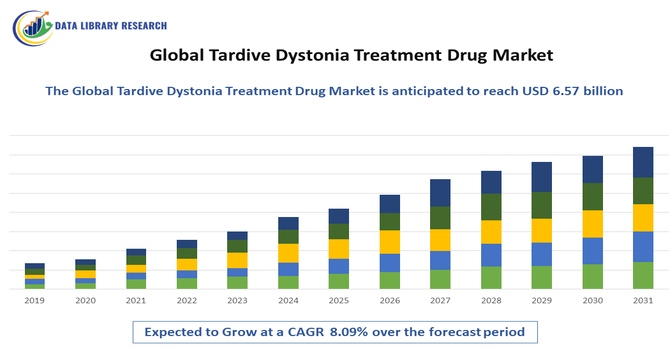
| Market Size Value | USD 6.57 billion |
| Growth Rate | CAGR of 8.09% |
| Forecast | 2026-2033 |
| Historical data | 2021-2024 |
| Base Year | 2025 |
| Report Coverage | Forecasted revenue, company rating, competitive environment, growth drivers, and trends |
| Segment Coverage | Type, Application, End-User, Geography |
| Regional Scope | North America, Europe, Asia Pacific, Middle East |
| Customized scope | Free customization of reports (With 3 months Analysis Support ) |
| To Learn More About This Report | Request a Free Sample Copy |
The global tardive dyskinesia (TD) treatment drug market features a highly competitive landscape, driven by both established pharmaceutical giants and emerging innovators. Key players dominate through the development and commercialization of vesicular monoamine transporter 2 (VMAT2) inhibitors, as well as other therapies aimed at improving patient outcomes. Companies are focusing on novel formulations, strategic collaborations, and clinical trials to expand their market presence and cater to growing patient needs. The competitive dynamics are further intensified by regulatory approvals, patent expirations, and the launch of new treatment options, fostering innovation and enhancing accessibility.
Major companies operating in the market include:
Recent Development
Q1. What the main growth driving factors for this market?
The market is primarily driven by the increasing global prevalence of Tardive Dystonia and other tardive syndromes, largely due to the widespread and long-term use of antipsychotic medications for mental health disorders. Additionally, growing awareness and improved diagnostic capabilities among healthcare professionals and patients lead to earlier intervention. Significant advancements in therapeutic options, particularly the development and approval of novel treatments like VMAT2 inhibitors, further fuel market expansion by offering more effective and tolerable solutions.
Q2. What are the main restraining factors for this market?
The most significant restraining factor is the high cost of approved therapies, such as VMAT2 inhibitors, which can limit patient access, especially in developing regions. Other restraints include the potential for adverse side effects associated with existing medications, which can impact patient adherence and compliance. Furthermore, a lack of awareness and delayed diagnosis in less-developed healthcare systems also act as a constraint on overall market growth.
Q3. Which segment is expected to witness high growth?
The Vesicular Monoamine Transporter 2 (VMAT2) Inhibitors segment is anticipated to witness high growth within the drug class segmentation. Drugs like valbenazine (Ingrezza) and deutetrabenazine (Austedo) have demonstrated proven efficacy in significantly reducing the involuntary movements characteristic of TD, positioning them as the preferred first-line pharmacological treatment. This strong clinical performance and favorable safety profile drive high adoption rates and market dominance.
Q4. Who are the top major players for this market?
Key players in the Global Tardive Dystonia Treatment Drug Market include companies that have successfully developed and marketed the primary approved treatments. Top major players are Neurocrine Biosciences, Inc. (for Valbenazine/Ingrezza) and Teva Pharmaceutical Industries Ltd. (for Deutetrabenazine/Austedo). Other significant companies involved in the broader dystonia treatment space include AbbVie Inc., Ipsen S.A., and Merz Pharma GmbH & Co. KGaA, often through their botulinum toxin products.
Q5. Which country is the largest player?
The United States (within North America) is consistently reported as the largest and dominant player in the global market. This dominance is attributed to several factors: a high prevalence of psychiatric disorders and subsequent antipsychotic use, a robust and advanced healthcare infrastructure, high healthcare expenditure, strong reimbursement policies, and the early approval and high sales volume of key therapeutics like VMAT2 inhibitors. North America holds a substantial majority of the global market share.
Data Library Research are conducted by industry experts who offer insight on industry structure, market segmentations technology assessment and competitive landscape (CL), and penetration, as well as on emerging trends. Their analysis is based on primary interviews (~ 80%) and secondary research (~ 20%) as well as years of professional expertise in their respective industries. Adding to this, by analysing historical trends and current market positions, our analysts predict where the market will be headed for the next five years. Furthermore, the varying trends of segment & categories geographically presented are also studied and the estimated based on the primary & secondary research.
In this particular report from the supply side Data Library Research has conducted primary surveys (interviews) with the key level executives (VP, CEO’s, Marketing Director, Business Development Manager and SOFT) of the companies that active & prominent as well as the midsized organization
FIGURE 1: DLR RESEARH PROCESS
Extensive primary research was conducted to gain a deeper insight of the market and industry performance. The analysis is based on both primary and secondary research as well as years of professional expertise in the respective industries.
In addition to analysing current and historical trends, our analysts predict where the market is headed over the next five years.
It varies by segment for these categories geographically presented in the list of market tables. Speaking about this particular report we have conducted primary surveys (interviews) with the key level executives (VP, CEO’s, Marketing Director, Business Development Manager and many more) of the major players active in the market.
Secondary ResearchSecondary research was mainly used to collect and identify information useful for the extensive, technical, market-oriented, and Friend’s study of the Global Extra Neutral Alcohol. It was also used to obtain key information about major players, market classification and segmentation according to the industry trends, geographical markets, and developments related to the market and technology perspectives. For this study, analysts have gathered information from various credible sources, such as annual reports, sec filings, journals, white papers, SOFT presentations, and company web sites.
Market Size EstimationBoth, top-down and bottom-up approaches were used to estimate and validate the size of the Global market and to estimate the size of various other dependent submarkets in the overall Extra Neutral Alcohol. The key players in the market were identified through secondary research and their market contributions in the respective geographies were determined through primary and secondary research.
Forecast Model